

Case study · Truck and diesel repair · Google Search
Elite Diesel Solutions: the first 8 days on Google Search.
A truck and diesel repair shop in Indian Trail, NC. The site, landing pages, ads and tracking I built, what the first 8 days brought in, counted the conservative way, and what is still open. Early numbers, re-read at 30 days.
 Elijah Nawrot · Google Partner · Updated October 6, 2026
The first 8 days
Elite Diesel Solutions, Indian Trail, NC. Google Search. 8 days, Sept 28 to Oct 5, 2026. Source: the Google Ads account and its call log.
Summary
| Client | Elite Diesel Solutions, a truck and diesel repair shop in Indian Trail, NC: heavy, medium and light duty trucks, trailers and diesel pickups. |
|---|---|
| Channel | Google Search: one campaign for shop repairs, one for road service and one for the business name. |
| Launched | Sept 28, 2026, at 5:51 pm Eastern. |
| Window | 8 days, Sept 28 to Oct 5, 2026. Oct 5 was the last complete day when I pulled the numbers. |
| Spent | $427.91, for 69 clicks |
| Leads | 11 calls and quote requests at $38.90 each, counted the conservative way |
| On the account's own count | 14 calls and quote forms at $30.57 each |
| Real conversations | 7 calls from the ads that ran over 2 minutes |
| What counts as a lead | A call from the ad of 30 seconds or more, a first-time call of 30 seconds or more from a landing page, or a quote form. A voicemail that long counts. |
| Source | The Google Ads account: spend by day, conversions by action, the call log and clicks by type, pulled Oct 6, 2026 |
| How early | Very. 8 days is a first read, not a rate. It gets re-read at 30 days, around Oct 28. |
Where it started
The shop came to me in July through an Instagram message. Its website was one page with no phone number, no address and no tracking. The Google Ads account held an old Smart campaign that had spent nothing in the year before launch.
Everything below was built from the shop's Google Business Profile and reviews, Keyword Planner, and the owner's answers to my setup form, before any money went to Google.
03
What I built
A new website
Rebuilt on a new domain, with a page for each main service, the shop's address and phone on every page, and its Google reviews quoted word for word.
Ten landing pages
One for each group of ads: truck repair, diesel repair, engines, transmissions, DPF and exhaust, suspension, body work, trailers, road service and fleets. Nothing on them links away.
Three campaigns
Shop repairs, road service and the business name. Exact match only at launch, so the ads show for the searches I picked, not loose matches of them.
Tracking that counts people
Calls from the ad count at 30 seconds, one per click. The landing pages use recorded tracking numbers. Quote forms reach a sheet and the owner's inbox the moment they are sent.
Two of the landing pages
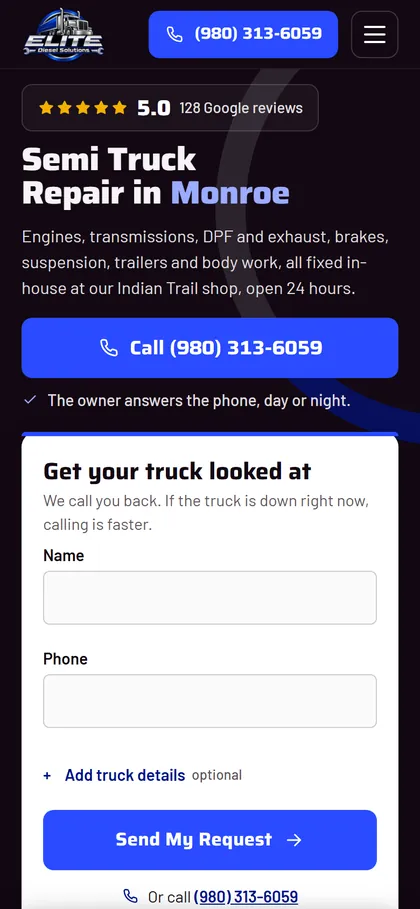
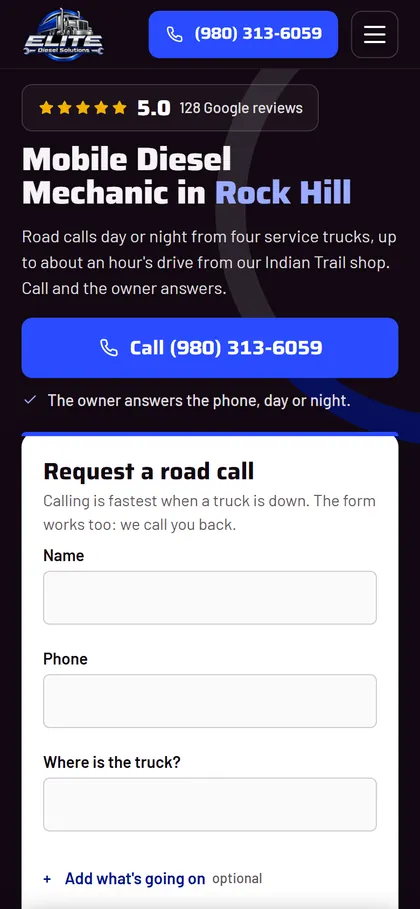
The truck repair page as a click from Monroe sees it, and the road service page as a click from Rock Hill sees it. Each headline names the service and the town Google reports for the searcher. The rating, a call button and a short form come first.
On the truck repair page the Send button is inside the first screen. The road service page also asks where the truck is, so it leads with the call button. The menu on both only jumps down the same page: the only ways out are a call or the form.
Why the ads are shaped this way
The owner's priority jobs are engines, transmissions, body and insurance work, DPF and exhaust, driveline and suspension. In Keyword Planner, transmission, body, DPF and suspension work barely register as searches by name. A trucker with a bad transmission searches "semi truck repair near me" or "diesel mechanic near me".
So each priority job keeps its own ad group and page, which costs nothing while nobody searches for it, and the general ads and pages lead with those same jobs, because that is where the money goes.
Road service is its own campaign. Those calls are urgent, often at night, and the clicks cost the most. A separate budget stops daytime shop searches from spending the money a truck broken down at 11 pm needs. There are fewer road service searches than the first plan assumed, so before launch I moved most of that budget to shop repairs.
Phrase match comes back one theme at a time, once the search terms stay clean.
Launch day
The ads went on at 5:51 pm on Sept 28, 2026. Three minutes earlier a test quote went through the form and reached the lead sheet and the owner's inbox.
Two settings changed that day. The ad's call conversion was counting every call from a click, so one trucker calling three times would have read as three leads. It now counts one per click. And the old Smart campaign was paused, so it could not switch on beside the new build with its own ads and goals.
The first 8 days
From 5:51 pm on Sept 28 to the end of Oct 5 the ads cost $427.91, for 69 clicks.
The account's own count is 14 calls and quote forms, $30.57 each: 10 calls from the ad's call button, 2 first-time calls from the landing pages and 2 quote forms. I quote fewer. Left out of the account's 14: a Sept 30 form that may have been a test, and two calls from area codes that had already called. That leaves 11, at $38.90 each.
Google doesn't pass on the number of someone who calls from the ad's button, only the area code, and sometimes not that. So a repeat caller here means an area code that had already called, and I left the second call out rather than risk counting one person twice.
7 calls from the ads ran over 2 minutes. Two of those came from area codes that had already called, so it may be fewer people than calls. A call that long is a conversation about a truck. It is not yet a booked job: I haven't been told which calls became work.
08
What is still open
Two missed calls
2 of 17 calls from the ads were marked missed: Oct 1 at 4:41 am, from the road service ad, and Oct 2 at 3:40 pm. No missed call after Oct 2, through Oct 5. Missed can also mean the caller hung up before the call connected. Google doesn't pass on those callers' numbers, so neither could be called back. Road calls come at night, when a truck is broken down, so after-hours answering is the first thing to settle with the owner.
The map listing on the ads
31 of 69 clicks went to the shop's map listing on the ads instead of a landing page, $169.73 of the spend. It is an account setting older than my build, most likely left by the old Smart campaign. Those clicks are not dead: the account credits them with 4 of its 14 calls and forms. But a call made from the map listing itself can ring the shop's main number, which is not tracked. Keep it or switch it off is my call, and I haven't made it yet.
Calls the tracking missed
From Sept 30 to Oct 5, a visitor who tapped Call before the landing page's tracking number loaded reached the shop's main line and was never counted. I fixed it on Oct 5: the number now loads with the page. How many calls that missed is unknown. It can only make the count low, never high.
What this does not show yet
It is 8 days. At this volume one call more or less moves the cost per lead a long way, and I don't quote a first week as a rate.
None of the 11 is a confirmed job yet. Calls from the ad's button aren't recorded, the two forms haven't been matched to the lead sheet, and the owner hasn't said which calls became work. A lead here is a conversation or a request, not a sale.
Before launch I forecast about 22 leads a month at about $55 each. That is a model built from Keyword Planner, it counted calls from 60 seconds where the account counts from 30, and 8 days can't test a monthly number.
The re-read is around Oct 28, with 30 days of calls, the landing-page recordings, the lead sheet and the owner's booked jobs. This page gets updated then, whichever way it goes.
Elijah Nawrot, founder of Red Orca Digital. Three years on roofs, four running paid ads for roofing companies. Red Orca is a Google Partner. More about me.
Last updated October 6, 2026
Read next
Your estimate
What would a lead cost in your trade?
Your trade and county, worked out live on a 30-minute screen share.
- No account access needed
- If the numbers don't work, I'll say so
- Your trade and county
- Pick a call time on the next screen
- 30-minute screen share